Moments on the glass: Live wires, weather reflexes, and the physical loop
A digital screen in a public venue is physical real estate.
It is not a web browser. It does not spawn popups, fire programmatic auctions on a 200-millisecond page reload, or leave a user staring at a broken spinner when a network connection drops.
A screen has a loop. Typically 60 seconds long, divided into steady, predictable slots. When an advertiser buys that loop, they buy presence in a physical room where real people walk past.
The commercial promise of digital out-of-home has always been that the creative could adapt to the moment: hot coffee when it pours rain, cold drinks in the summer heat, sports celebrations when the local team wins, or a flash promotion when inventory in the store needs to move.
Yet for twenty years, dynamic DOOH has been notoriously fragile. It was either crippled by Byzantine ad-tech plumbing that treated physical venues like mobile banner exchanges, or built on bespoke, brittle custom integrations that broke the moment an API lagged.
Here is how Foro approaches dynamic creative: by treating it as creative routing within already-booked inventory, governed by physical loop reality, fail-closed safety, and a two-way handshake contract.
When the loop turns, what plays?
The first mistake ad-tech makes with digital signage is assuming content can or should crossfade mid-sentence.
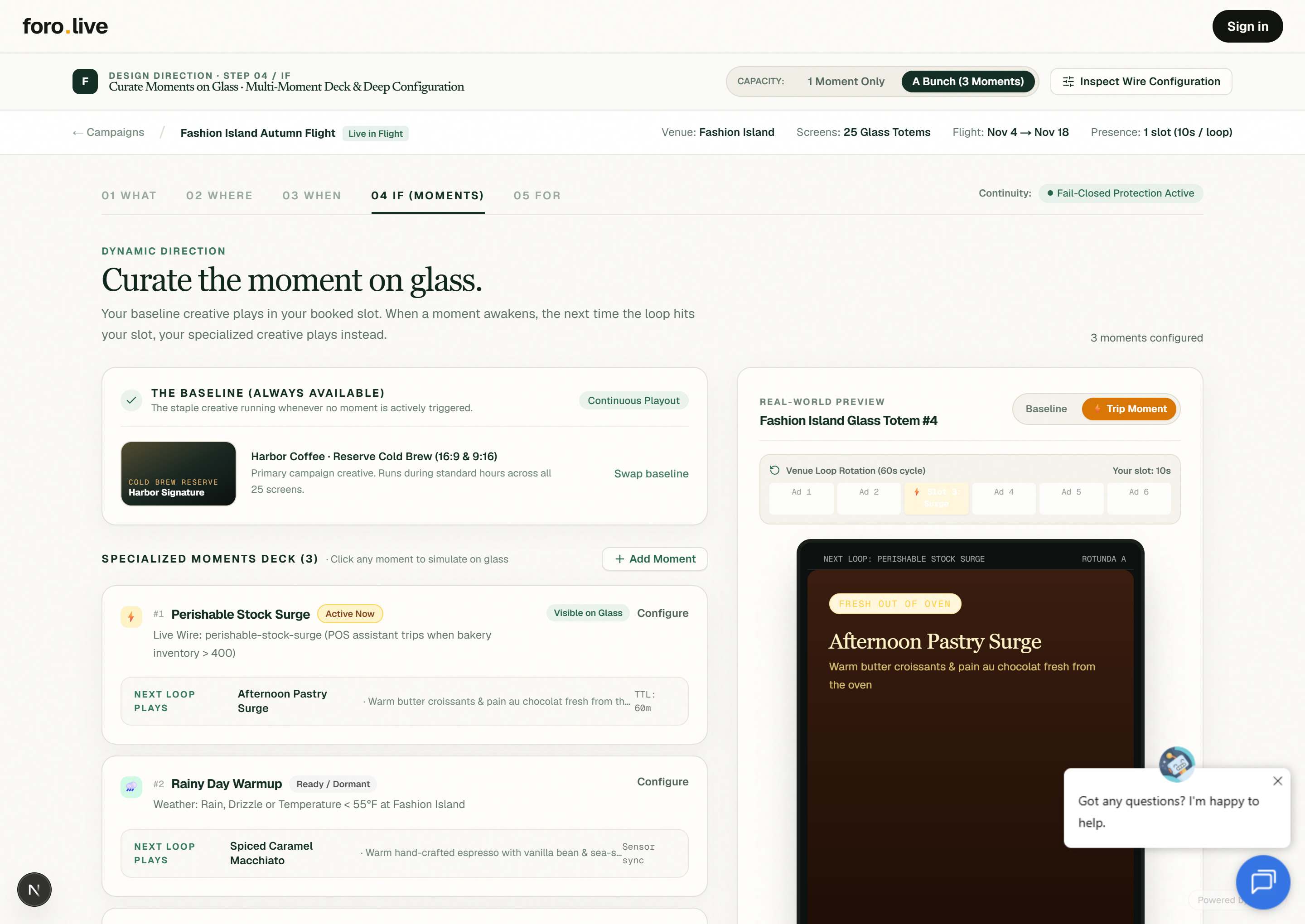
A DOOH player operates on loop cadence. When a campaign holds a 10-second slot in a 60-second rotation, the player evaluates current conditions right when the slot begins: which creative plays right now?
If it was clear skies when the hour began, the screen plays the standard baseline creative. If a sudden thunderstorm rolls in while the third slot is playing, the player doesn't panic or cut off the ad. The loop keeps turning. When the loop hits your slot again, the weather reflex triggers, and your rainy-day creative takes the glass.
Three kinds of moments
Not every campaign needs five layers of automation. A neighborhood bakery might only want a warm croissant ad when it rains. A national airline might want live gate updates, weather adaptations, and airport concourse triggers running simultaneously.
Foro organizes moment intelligence into three distinct, fail-closed categories:
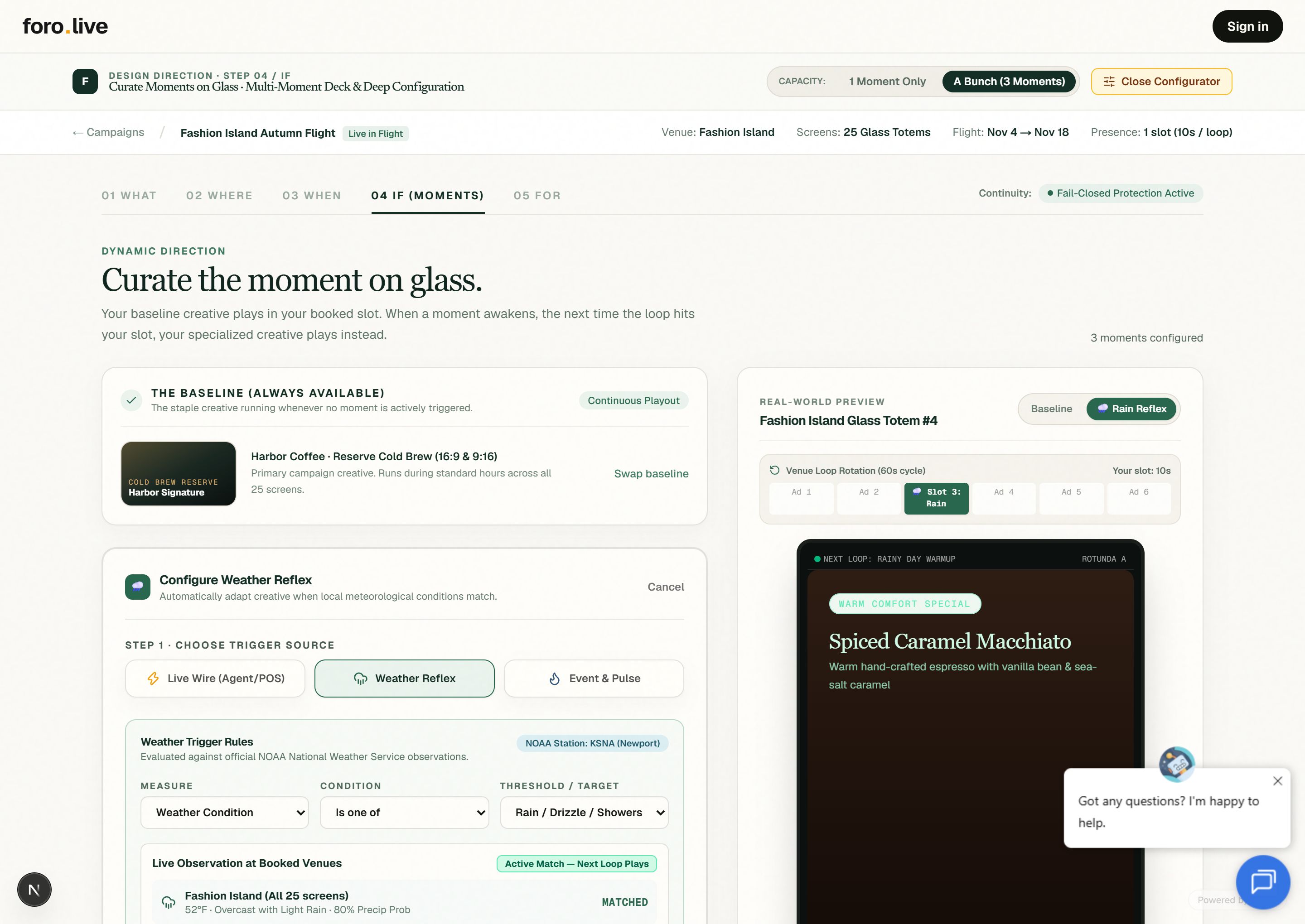
- Weather Reflexes: Connected to live NOAA meteorological observations. If the local sensor registers rain, snow, overcast skies, or temperatures above 30°C, the player automatically routes to the matching reflex creative.
- Market Moments & Pulses: Curated civic and cultural calendars. Stadium concerts, major league game days, marathon finishes, and weekend nightlife rushes. Moments are known in advance, allowing brands to curate creative for the crowd walking past.
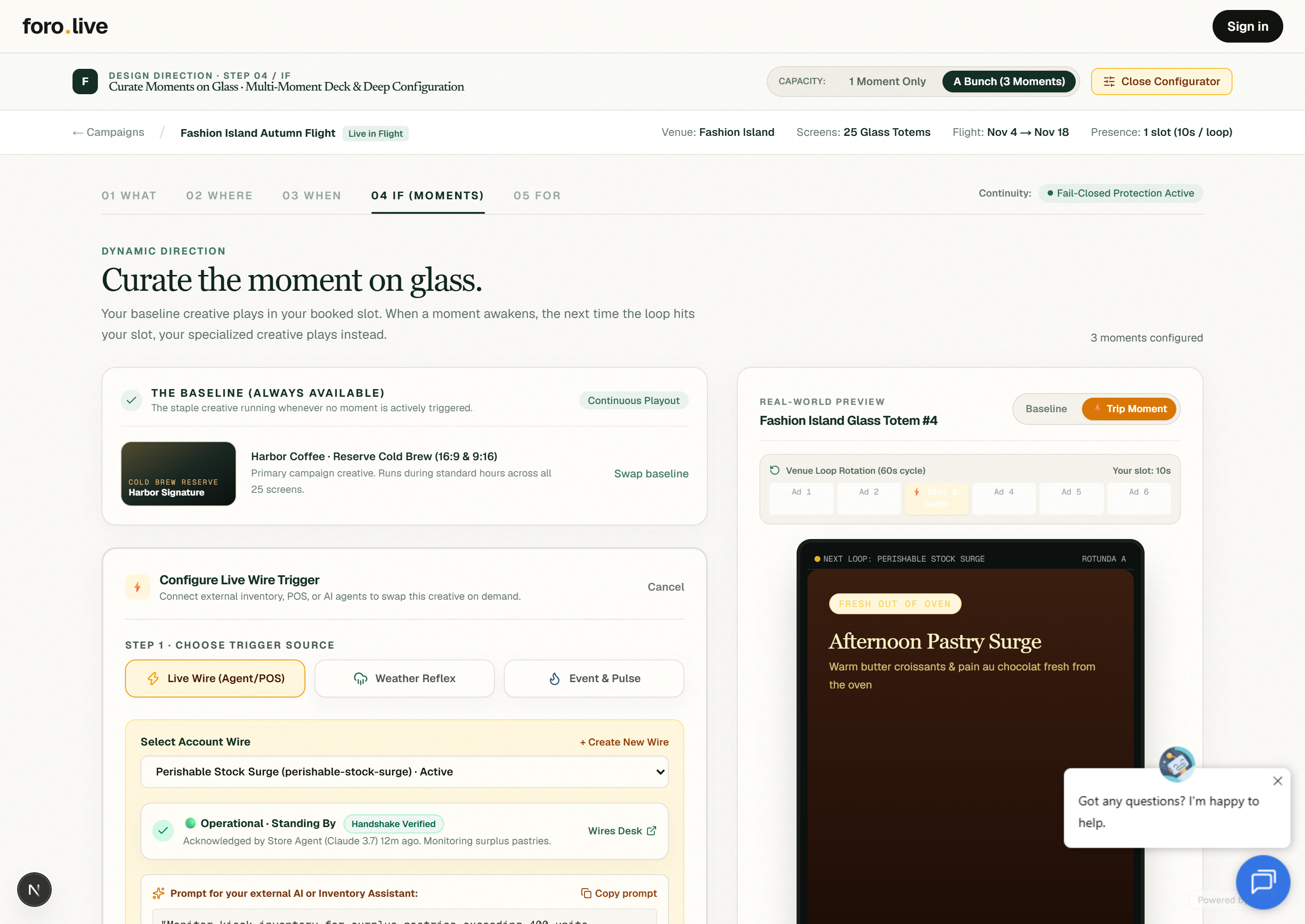
- Live Wires: Real-time machine event trips. A point-of-sale system, an inventory webhook, a sports API, or an autonomous AI marketing agent trips an event signal to swap creative across target screens instantly.
Fail-closed: The law of physical continuity
On the web, if a creative server fails to respond, an ad slot remains an empty gray rectangle.
On a ten-foot high-brightness totem in the center of an upscale shopping mall, a blank screen or an HTTP 504 error is a catastrophe. It damages the venue's reputation and breaks the advertiser's contract.
In Foro, screens never fail open.
Every moment rule is subordinate to the campaign's baseline creative. Furthermore, every Live Wire requires a mandatory lease Time-To-Live (TTL). When an external webhook or an agent trips a wire, it must declare how long that moment remains valid — whether 15 minutes for a flash deal or two hours for a sporting event.
If the external system goes offline, if the agent crashes, or if no renewal pulse arrives before the lease expires, the player immediately and silently falls back to the baseline creative. The glass never flickers. Playout continuity is mathematically guaranteed.
The two-way agent handshake
As more advertisers connect autonomous AI assistants — such as ChatGPT, Claude, Grok, or custom sales bots — to their Foro accounts via MCP, a new operational challenge emerges: how do you avoid brittle dependencies between human intent and machine execution?
If an advertiser sets up a Live Wire called weekend-flash-sale, how does their AI assistant know it is expected to monitor and trip that wire? And how does the human buyer know the AI is actually on duty?
Foro resolves this with an automated two-way handshake contract.
Whenever an AI assistant connects to Foro, Foro automatically bundles the account's active Live Wires, their trigger keys, and human guidance into the assistant's initial session brief. The assistant inspects the assignment and returns an acknowledgment signal.
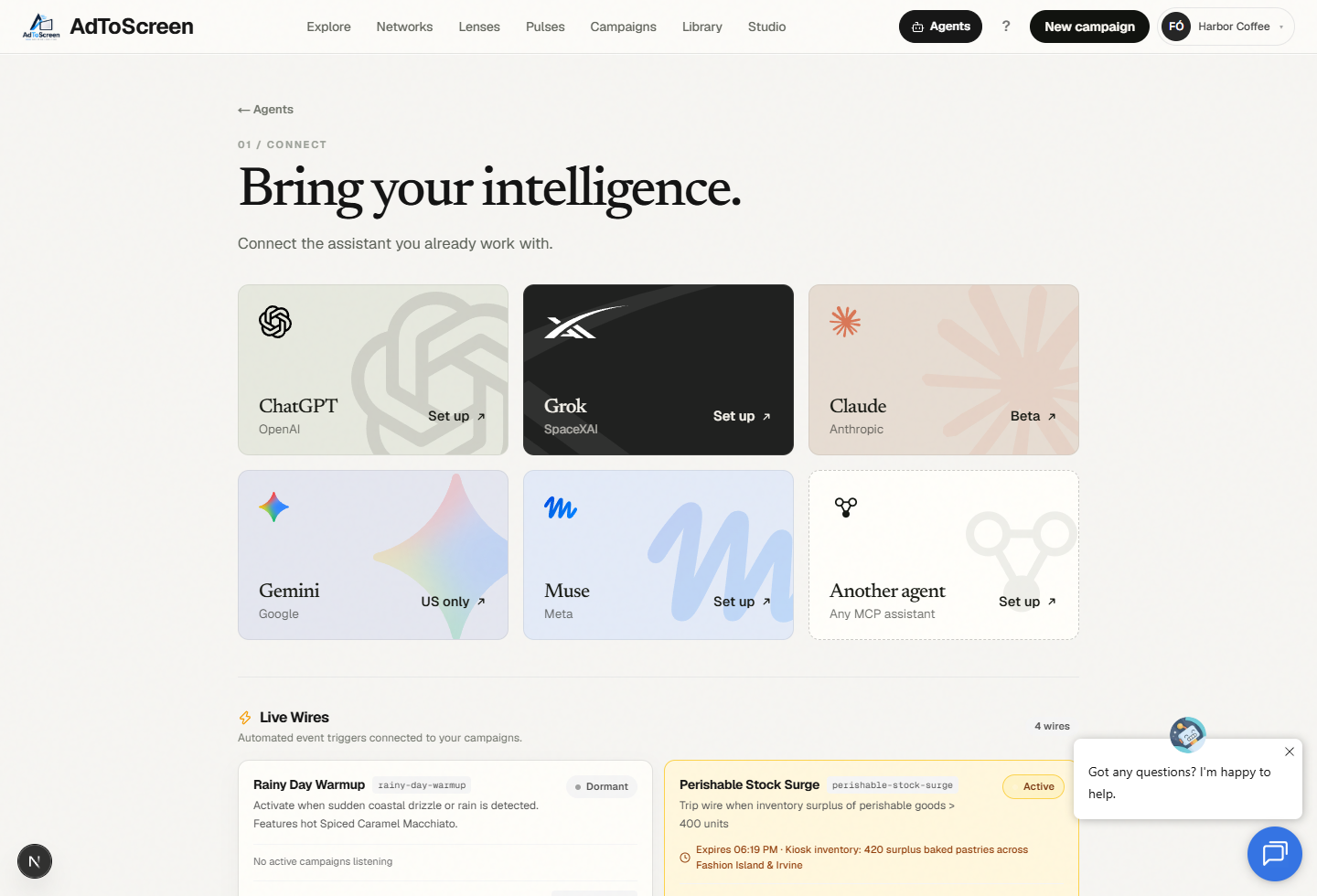
This state is surfaced directly on the Live Wires Desk (under Agents) and within the campaign builder as an unmistakable traffic light:
- 🟢 Operational: The assigned agent has connected and acknowledged within the past 24 hours. The wire is healthy and ready to trip.
- 🟡 Pending Handshake: The wire has been configured in a campaign, but no connected assistant has acknowledged it yet.
- 🔴 Safe Baseline:The assistant's acknowledgment is stale or missing. The campaign continues to play its approved baseline media with zero downtime.
Direct selling, intelligent glass
Foro does not ask venue operators to surrender their glass to a third-party black box, and it does not force advertisers through algorithmic auction rings just to run an ad when it rains.
The advertiser buys the inventory directly. The network operator retains full control over their pricing, approvals, and screens. And when the real world changes — when the temperature drops, the crowd surges, or the signal trips — the glass responds cleanly, beautifully, and reliably.